What is it about?
This project is part of the Marolles sustainable district contract (2018-2022).
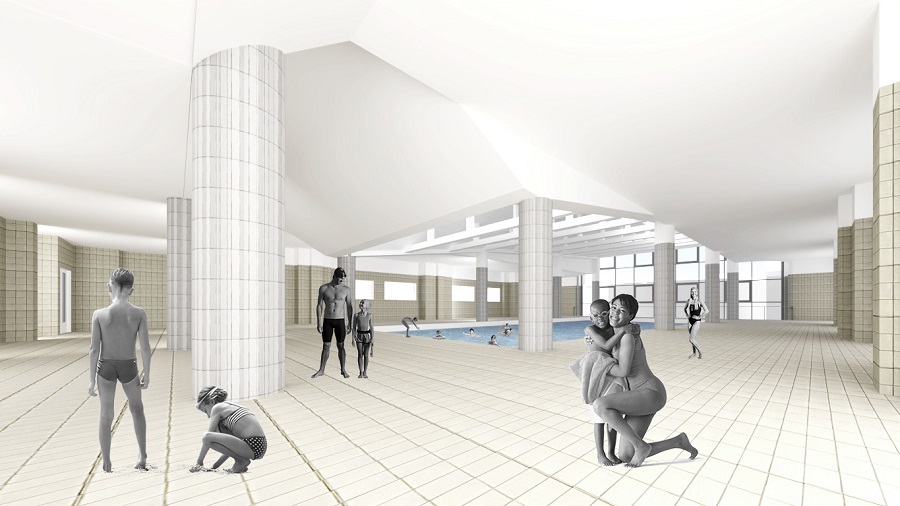
Strategically located between the Palais de Justice law court and the lower town, the Baths of the Centre play an essential role in the sports infrastructure offered by the City of Brussels. Inaugurated in the early 1950s and with 10,000 showers taken there a year, it is an iconic site with an undeniable social dimension, particularly for the Marolles neighbourhood. The upcoming works will aim to make the building more accessible and modern, while enhancing its heritage and preserving its social role.
As well as restoring the swimming pool and completely renovating the existing showers, the project also involves the overall redevelopment of the facility to optimise its use and improve its accessibility.
The works include modifying the existing pavement by removing the steps to facilitate access for people with reduced mobility and all users. The original entrance gate will be restored. The main entrance will be via Rue du Chevreuil, while the Rue des Capucins entrance will be reserved for technical services and deliveries. This configuration creates an internal street on the ground floor of the building linking the two roads, around which the various units of the Baths will be built.
The other sports halls of the complex will also be redesigned and opened to the public:
- The boxing hall will be extended to increase its use
- A rest room for staff and a small dojo
- The gym
- A multi-purpose hall
The visibility and appeal of the Baths will be enhanced by the creation of a roof space to complement the refurbished cafeteria.
During the works, the swimming pool will remain open as long as possible to minimise the impact on users.
What purpose?
- Rationalising the management and use of municipal sites by applying the concept of 'chrono-urbanism'
- Responding to the lack of sports facilities
- Encouraging the reconcentration of city facilities and services within multi-purpose, shared neighbourhood facilities hubs
- Converting municipal and public buildings into key players in improving the urban climate
