This event has already passed
The City of Brussels invites you to discover the work of architect François Malfait through an exhibition highlighting the many facets of his architectural work.
Explanatory panels at the Bourse-Beurs introduce you to this multi-faceted personality and some of his outstanding achievements.
The exhibition, accessible without reservation, was launched as part of the Art Deco Heritage Days 2025.
/francois-malfait-1872-1955-exhibition

A particularly brilliant personality, François Malfait headed the Architecture Department of the City of Brussels between 1912 and 1942, a period that coincided with the rise and triumph of the Art Deco style.
As the designer of buildings, urban developments and monuments, as well as responsible for various renovation and restoration projects, François Malfait played a major role in the architectural and urban development of Brussels.
As the son and grandson of sculptors and decorators, François Malfait began his career in the family workshop before turning to architecture. He trained with the architect Capronnier, among others, before continuing his apprenticeship with study trips to Italy and visits to the major museums of Europe.
Although his name remains little known, many of his creations are familiar landmarks in the Brussels landscape, such as the Robert Catteau Atheneum, one of his most emblematic works. He is also responsible for the former School of Medicine on Boulevard de Waterloo and the extension of the Théâtre Royal du Parc, two projects that attracted admiration even from abroad.
Furthermore, François Malfait works on the restoration of historic buildings such as the Hôtel Ravenstein and several houses on the Grand-Place. He is also responsible for temporary decorations for major events such as the 1935 Brussels International Exposition, for which he designed the "lighting effects" and built the "Palais de la Ville de Bruxelles".
Marked by extremely varied projects, François Malfait's career as chief architect of the City of Brussels demonstrates his ability to juggle styles from the past, his remarkable adaptability to constraints and his aptitude for evolving his work towards modernity.
A great talent to discover!

Rue Ernest Allard 49, 1000 Brussels
1923-1927 I Registered in the legal inventory on 19 August 2024
Theme: Art Deco construction
François Malfait's masterpiece, the Robert Catteau Atheneum is also an urban planning feat. Built on a plot of land between Rue Allard and Rue des Minimes, it compensates for a height difference of more than 16 metres while complying with height restrictions designed not to obstruct the view of one of Brussels' most beautiful panoramas.
Inaugurated in 1927, the establishment meets "the latest requirements of modern pedagogy" with a functional design and aesthetics typical of the interwar period. The building comprises five wings arranged around two courtyards. On the façades, the Art Deco style is expressed through a combination of materials with varied textures and colours - yellow and red bricks combined with white and blue stones - tempered by clean lines and simple geometric patterns.
Facing Rue des Minimes, the former main entrance, emphasised by a projecting section, is surmounted by a pediment framed by two sculpted groups bearing the inscription 'Ecole Moyenne'. The building on Rue Allard has a more modest façade, but is made entirely of white stone.
Inside, in addition to classrooms and staff rooms, the atheneum's facilities include a conference room - which can be converted into a cinema - and display cases, designed on the principle of the "school museum", dedicated to furthering students' knowledge through exhibitions.
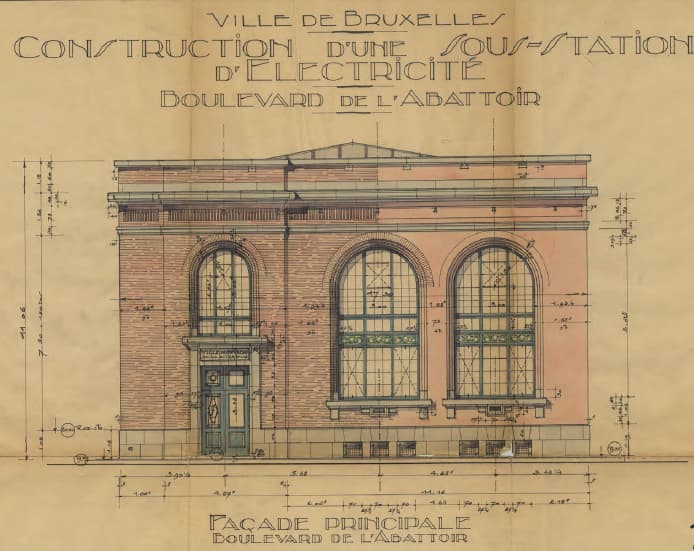
Boulevard de l'Abattoir 9, 1000 Brussels
1927-1930 I Listed since 8 December 2016
Theme: Art Deco construction
In Brussels, the use of electricity gradually became widespread from the end of the19th century onwards. Produced as direct current in a central power station, this energy then had to be converted into alternating current in substations to make it suitable for domestic use. Along with the one on Rue Luther, which no longer exists, the substation on Boulevard de l'Abattoir is one of the last of these facilities to be built in the Brussels area.
The building is located on the site of a fortified building of the second city wall of the 14th century, replaced at the beginning of the 19th century by a neoclassical lock.
François Malfait first attempted to adapt the structure, which had been rendered useless when the course of the Senne was altered. After several sketches inspired by vernacular style, he presents a project with an Art Deco aesthetic and modernist tendencies. The building retains its local identity thanks, in particular, to the use of blue stone and Boom brick. Large metal skylights illuminate the machine room, which originally occupied the entire height of the building. Inside, a travelling crane and a walkway at mid-height allowed for maintenance of the installation.
Decommissioned in the late 1930s following advances in electricity distribution, the property was leased to the editorial staff of a sports newspaper, which had the original space subdivided into two levels. Restored in the 2010s, it is now occupied by the Institut des Arts et Métiers.

Boulevard de Waterloo 115, 1000 Brussels
1924-1928 I Registered in the legal inventory on 19 August 2024
Theme: Art Deco construction
This monumental complex, built by François Malfait with support from the Rockefeller Foundation, consists of three buildings connected by transverse wings.
Concrete was chosen for the framework because it allowed for the creation of large spaces whose partitions could be adapted as uses evolved.
The architectural programme is therefore based on a construction concept previously devised by engineer Eugène François. However, the masonry does not merely serve a decorative feature: it also plays a structural role.
True to his personal style, the architect chose blue stone and flamed brick for the façades, giving this Art Deco complex a vernacular look. Both the exterior and interior feature many composition elements similar to those found in the Robert Catteau Atheneum, built in the same period.
In 1993, the building was raised by a glassed-in attic floor, built above the projecting cornice by architect François Schilling. After the School of Medicine moved out, the Ministry of Justice occupied the premises. The building is currently available for reallocation.
Jacques Marin (1877-1950)
Facing the boulevard, the main entrance is highlighted by a sculpted gate. The two Atlantean figures supporting the monumental canopy and the spheres encircled by snakes above it are the work of sculptor Jacques Marin, with whom Malfait collaborated on several occasions.

Avenue du Cimetière de Bruxelles 114-116, 1140 Evere
1934-1935 I Registered in the legal inventory on 19 August 2024
Theme: Art Deco construction
In 1934-1935, the City built a garage for hearses near the Brussels cemetery, located in the municipality of Evere. Its aim is to modernise and improve the efficiency of its facilities by replacing its horse-drawn hearses with motor vehicles. The project is entrusted to François Malfait.
The use of traditional materials - brick and blue stone - frequently chosen by the architect in his Art Deco designs is now tempered by a clearly Modernist style, abandoning ornamentation in favour of a very sober composition with rigorous geometry.
With the exception of its gate, the street façade is characterised by horizontal lines reflected in a series of finely coordinated architectural elements: a pronounced base, continuous window sills and lintels, and projecting cornice line and canopy. This horizontality is echoed on a smaller scale by the divisions of the window frames, the ornamental ironwork and the inscription 'Ville de Bruxelles - Service des inhumations' (City of Brussels - Burial Service).
The architect's meticulous attention to detail is evident both inside and outside.
To the left of the gate, the ground floor was occupied by offices and the first floor by the caretaker's lodgings. To the right, on a single level, was the drapery warehouse.
The garage itself is located inside the block. It consists of a vast hall covered by a reinforced concrete arched beam structure, with a small annex occupied by the repair workshop.
Now privately owned, the building is currently undergoing a conversion project to convert it into housing.

Heysel Plateau
1935 I Temporary pavilion - Demolished
Theme: Art Deco construction
In 1935, François Malfait designed a pavilion for the Brussels World's Fair to showcase all the activities of the municipal administration.
Covering an area of nearly 5.000 m², the Palace of the City of Brussels had around 60 metres of façade divided into two wings. The entrance was marked by a monumental tower, whose the height counterbalanced the building's marked horizontality. For this Art Deco building with modernist tendencies, the architect developed a harmonious interplay of simple volumes, which he combined with numerous decorative details. Examples of this include the gold-plated statue of Saint Michael above the entrance and the sculpted frieze dedicated to the Arts, Sciences and Crafts that ran along the side façades.
At the rear, the wings of the building were connected by a pergola delimiting an interior garden designed by landscape architect Jules Buyssens, who was in charge of the City of Brussels' planting service.
Both sober and elegant, the Palace of the City of Brussels was a real "architectural success" during the event.
The Architecture Service's presentation
The office headed by François Malfait exhibited its work in one of the 24 stands that occupied the wings of the pavilion. Among the plans on display were those for the Laeken cemetery, the fountain in the inner garden of the Palace of the City, the École Moyenne A (now the Robert Catteau Atheneum), the Théâtre Royal du Parc and the Waux-Hall. Models also showed the new entrance to the Laeken cemetery and the extension of the funeral galleries.
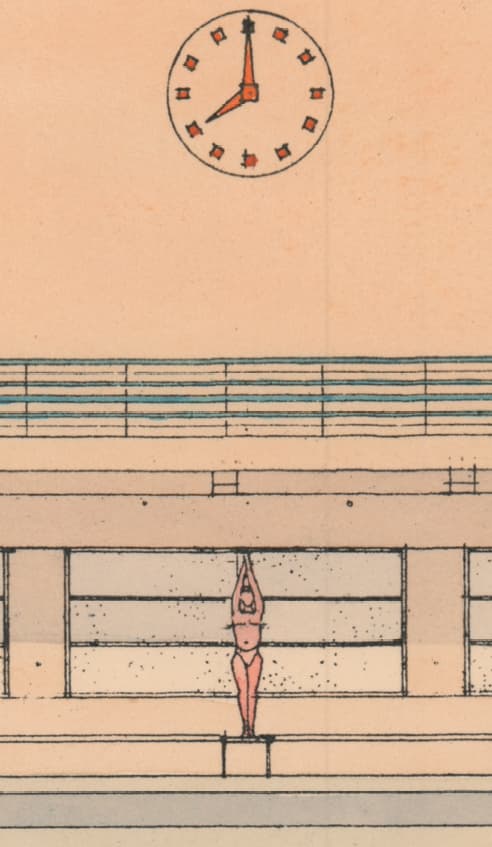
Rue Wittouck, 1020 Laeken
1936 I Uncompleted
Theme: Art Deco construction
Shortly after Rue Wittouck was created in 1915, the municipality of Laeken commissioned architect Henri Jacobs to develop a large municipal school complex for boys. In 1918, this specialist in school architecture submitted a detailed preliminary design, with eclectic-style buildings arranged around two courtyards, including a gymnasium and a swimming pool.
After Laeken was annexed by Brussels in 1921, a scaled-down version, this time in the Art Deco style, was presented by the same architect. Deemed disproportionate given the local demographic situation, this project was also rejected.
In 1936, François Malfait is tasked with drawing up plans for a primary school on this site. The architect proposes a modernist building with dynamic, horizontal lines, including a school swimming pool and even an air-raid shelter. The colour plans demonstrate his originality and, as always, his attention to detail. The materials used are mainly brick, blue stone, varnished ceramics and metal frames. However, the project was once again postponed due to the war.
In 1953, the Dutch-speaking Louis Wittouck primary school was built on this site, based on plans by architect Maxime Brunfaut.
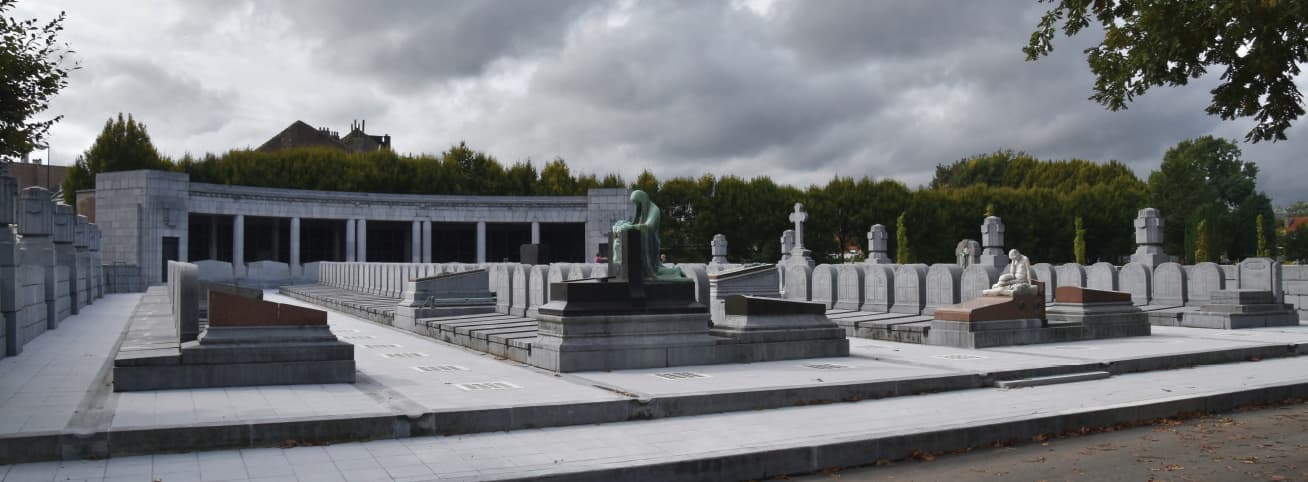
Parvis Notre-Dame, 1020 Laeken
1933-1935 I Listed since 14 January 1999
Theme: Art Deco construction
The Laeken cemetery comprises a vast complex of funeral galleries, punctuated on the surface by commemorative monuments. Built in several phases, this complex was completed between 1933 and 1935 with a final intervention by François Malfait.
The architect designed three parallel underground galleries in reinforced concrete - a key material of the interwar period - connected by a fourth, curved gallery. At each of its ends, two staircases lead to a monumental, arc-shaped peristyle with clean lines. Built in blue stone, it houses steles and a few monuments bearing the names of the deceased buried in the basement.
François Malfait also provided the cemetery with a new entrance on the forecourt side, consisting of a monumental gate and two buildings for administrative offices and public toilets. Initially, the project also included an above-ground funeral gallery and a rotunda to be built on the Grande Avenue side.
A true innovation
The initiative to create the first funeral gallery in Belgium and Northern Europe came from Émile Bockstael (1838-1920), alderman for public works and engineer by training. Inaugurated at the Laeken cemetery in 1878, it was probably inspired by the Campo Santo in Pisa, dating from the 13th, from which it nevertheless differs in that it is built underground.
The funeral galleries in Laeken quickly became a model for other municipal cemeteries. This new form of burial offered significant advantages, particularly in terms of hygiene and management of available space.
.jpg)
Place de la Bourse, 1000 Brussels
1924-1932 I Listed since 19 November 1986
Theme: Art Deco renovation
Alongside new constructions, François Malfait also excels in renovation projects, some of which are historicising, while others are more radically modern. Each time, he responds to a precise and demanding programme.
In the 1920s, stock market transactions were becoming increasingly popular. The plans drawn up by the architect for the Stock Exchange met the needs of the ever-growing number of stockbrokers, as well as new communication technologies such as the telegraph and telephone.
A basement level is developed beneath the entire surface of the building, wide walkways are laid out on the first floor, and a second floor is built with subtlety and discretion behind the existing attic walls. Lifts, new stairwells and two escalators ensure smooth connections between the different floors.
The mark left by François Malfait on the building is a blend of classicism, for the parts visible to the public, and resolutely contemporary interventions in terms of forms and materials, such as the spaces with segmental beams in the second-floor offices and the recurrent use of glass slabs.
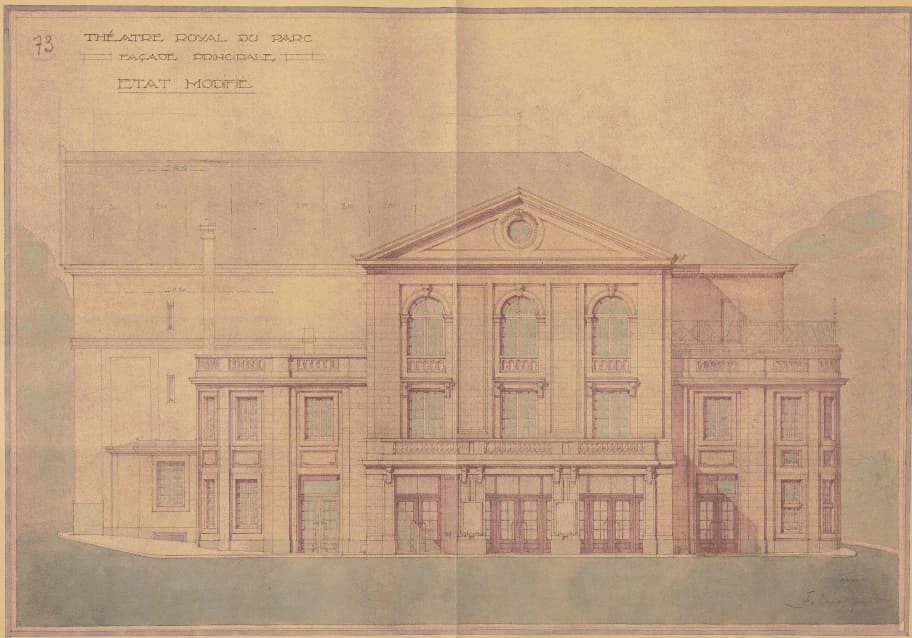
Rue de la Loi 3, 1000 Brussels
1933 I Listed since 19 May 1994
Theme: Art Deco renovation
Built in 1782 under the name Petit Théâtre, based on plans attributed to architect Louis Montoyer, the Royal Theatre of the Park has undergone numerous transformations and embellishments. François Malfait is responsible for the most significant renovation, carried out in 1933. This involved extending the auditorium to the old outer walls in order to increase its capacity to 740 seats, and providing the theatre with a large entrance hall preceded by a wide portico designed to shelter visitors arriving by car from the elements.
This work, which is akin to a partial reconstruction, was quickly completed thanks to the use of reinforced concrete in the auditorium and its ambulatory, for the Art Deco grand staircases covered in red marble, and for the set of external emergency stairs.
François Malfait had previously travelled to Paris to discover the most modern theatres of the time. The new rounded annexes may therefore have been inspired by the Théâtre des Champs-Elysées (architect Auguste Perret).
Inside, François Malfait remains faithful to a classical style. He recovers the caryatids from 1860 and recreates a new Louis XVI-style décor in green and gold, in keeping with the tradition of 18th-century theatres.

Marché au Bois, 1000 Brussels
1915 and 1921-1922 I Currently being registered to the Safeguarding List
Theme: Urban planning
The Square du Marché au Bois is the result of urban transformations that began in 1903 with a view to creating the North-South railway junction. Designed to develop and embellish the surroundings of the future central station, this green space is home to Victor Rousseau's sculpted group "La Maturité" (Maturity). Following the presentation of a scale model of the work at the salon of the association 'Pour l'Art', in 1913 the City of Brussels commissioned the artist to create a monumental marble version, around which François Malfait designed the square.
Conceived in 1915, the project did not come to fruition until 1922 due to the First World War. It is the result of close collaboration between the architect, the artist and the landscape architect Jules Buyssens.
The square is triangular in shape with rounded corners. In the corner at the highest point, two staircases lead to the sculpture, which stands out against a backdrop of greenery, placed there at Rousseau's request. Originally, dolomite paths, grassed areas and three circular flowerbeds punctuated the space. The whole also features a blue stone balustrade. For its design, Malfait borrowed an interlacing motif found on the neoclassical buildings bordering the Place Royale and on some of the eclectic buildings directly surrounding the square. The use of this historical reference allows the architect to reinforce urban unity by subtly connecting the upper city and the lower city.
Baron Horta
François Malfait is also responsible for the redevelopment of Rue Baron Horta, located a few steps from Square du Marché au Bois. For this other connecting axis between the upper city and the lower city, between 1921 and 1923, the architect designed a monumental staircase in a neoclassical style, incorporating a green space adorned with a fountain called "Naïades" by Jacques Marin.
Interlacing motif
Malfait would use the interlacing motif from the balustrade of the Square du Marché au Bois on several other occasions. Modernised versions of this motif can be found at the Théâtre Royal du Parc and the Waux-Hall.
.jpg)
Brussels Park
1913 I Listed since 19 May 1994
Theme: Historicist construction
The Brussels Waux-Hall is inspired by London's Vauxhall Gardens, pleasure gardens where open-air balls and concerts were held. It was established in Brussels Park in 1782 by the Bultos brothers, based on plans by architect Louis Montoyer, and consists of a theatre, a café-restaurant and shops.
At the beginning of the 20th century, following numerous transformations of the site, only the part free of any construction was called Waux-Hall. After an initial project by architects Petain and Hamesse was rejected in 1910, the City called on architect François Malfait in 1913 to enhance the area. Inspired by landscape architecture and, more specifically, by the art of latticework, which reaches its peak at Versailles, he offers a completely original ensemble.
A gallery leads walkers from the Cercle Gaulois, located behind the Théâtre Royal du Parc, to a tree-lined dance floor and an orchestra pavilion, all made of latticework. The horseshoe-shaped gallery is topped by a dome at its centre. Vases punctuate the attic crowning the buildings. Originally, statues occupied the now empty niches.
Opened only in the early 1920s due to the First World War, and quickly abandoned in favour of dance halls, the Waux-Hall dance floor remained deserted. It was not until 2016 that the complex was once again opened to the public for the "Vaux Hall Summer", following extensive restoration work.