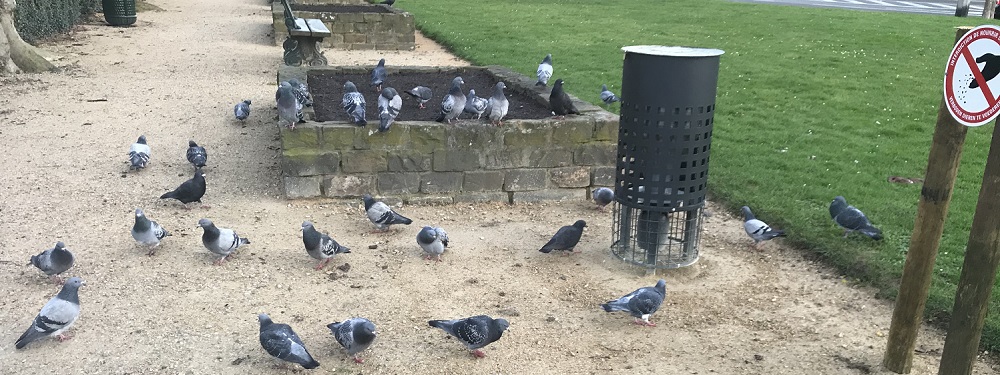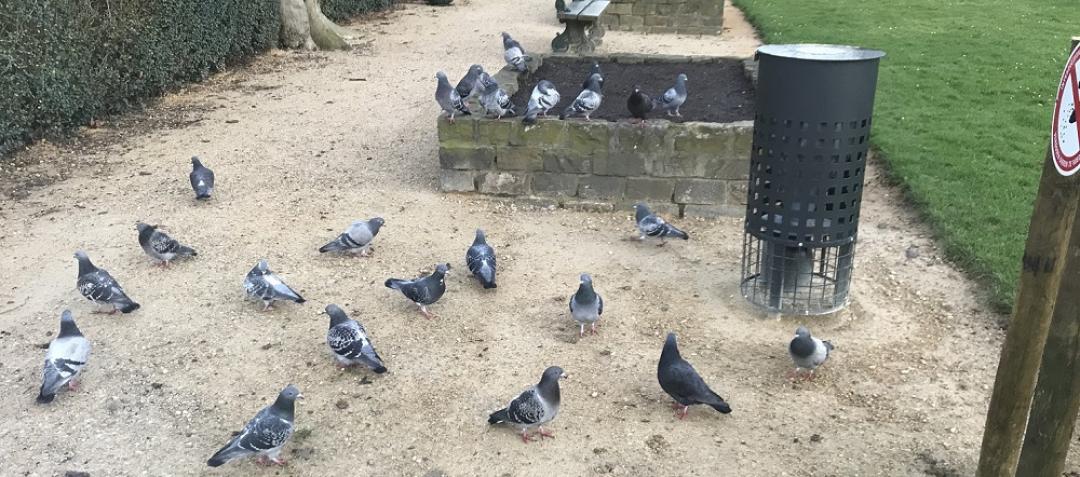
The City of Brussels is testing a new method to control the pigeon population: contraception. Each day, at a fixed time, the pigeons receive a dose of contraceptive corn kernels.
Rock pigeons adapt well to city life. It is also in the city that they find a lot of unsuitable food, but with which they can reproduce throughout the year (12 chicks per year). Moreover, they have few predators. The result: a pigeon overpopulation and a lot of nuisance. That is why the City is now testing contraceptive corn kernels.
Next video shows the distribution of contraceptive seeds to pigeons (the video contains no dialogue or text):
The City of Brussels has already installed several distributors of contraceptive seeds.
The corn is covered with a medicine against parasites for birds. But that medicine has a side effect: contraception.
No, this side effect is temporary. All you have to do is stop the corn intake to get young pigeons again.
No, the active substance is present on the seeds in a very low dose. People need to eat kilos of it to feel the effects.
In order to be a risk, the grains must remain after the passage of the pigeons. This is not the case because the amount is calculated on the basis of the pigeon population.
If seeds are left by accident, the other birds are not at risk because they have to eat them every day to get the contraceptive effect. Moreover, sparrows, tits and other small birds in the city do not eat corn kernels.
Dogs and cats do not eat corn kernels either. The amounts needed for any effect are so large that dogs or cats should eat the daily dose of the pigeons every day.
No, feeding wild animals is prohibited by the general police regulation (article 35) under penalty of a fine.
Nevertheless, additional feeding of pigeons, strictly regulated by the City, is sometimes allowed around the distributors to get the pigeons used to it. For this, one must obtain a feeding permit from the City of Brussels.
The first seed distributor was installed at the Square Clémentine in the autumn of 2019. At the start of the project there was a population of approximately 250 pigeons. The decrease in the pigeon population in February 2023 was 66%.