The Asian hornet (Vespa velutina nigrithorax) is not much more dangerous than the European hornet. When alone or feeding, it is not aggressive. Its venom is no more dangerous to humans and animals than that of a wasp. The Asian hornet, however, poses a major risk to biodiversity and local insects.
A nest of the Asian hornet consumes 11.32 kg of insects per season (97,000 insects). One study showed that a single worker crop contained the remains of 159 different species of insects.
Moreover, the Asian hornet also has an economic impact on beekeeping and fruit production, as it attacks honey bees that produce honey, as well as orchards (by eating ripe fruit).
The Asian hornet has no natural enemies in our regions. It is therefore up to us to limit its spread.
External siteThe Asian hornet: fact or fable? (in French and Dutch)
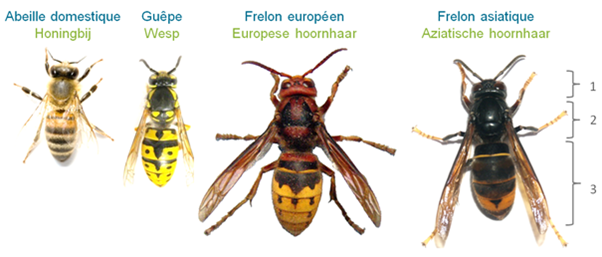
The Asian hornet is slightly smaller than the European hornet. It is black with a yellow band on the abdomen and bright yellow legs. In flight, it resembles a large black wasp with a yellow band.
The European hornet has brownish-red legs and a thorax. Its abdomen is yellow with black stripes. Its colours are brighter and it looks more impressive than the Asian hornet.
Asian hornet's nest
The Asian hornet builds two nests: a primary nest in spring and a secondary nest in early summer.
After winter, starting in March, young queens establish embryonic nests that develop into primary nests once the workers are born. The queens build this nest at medium height, for example in a hedge.
The primary nests grow, and when they are too populated and the space around the nest hinders further development, the colony usually moves from June onwards. It then builds a secondary nest higher up in trees (coniferous or deciduous), often at a height of more than 10 metres.
Sometimes a nest is built on a building or the primary nest at human height is not abandoned but further developed into a secondary nest. These low-lying secondary nests pose a particular danger to gardeners trimming hedges.
Nests are never reused from one year to the next. Nests still visible in winter are decaying.
Spring capture of the founding queens
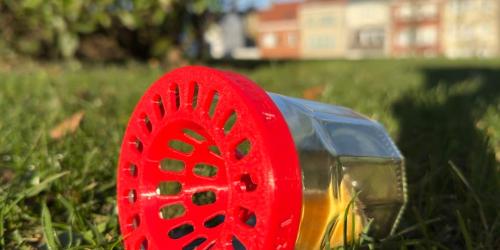
The traps are used to catch the founding queens (gynes) of Asian hornets before they can start a new colony:
Spring capture of the Asian hornet
How to report a nest?
If you see a primary or secondary nest of Asian hornets on the territory of the City of Brussels, report it on the following Facebook pages:
- External siteVespa hunter 1000 BXL (Brussels)
- or External siteVespa hunter 1020 BXL (Laeken)
- or External siteVespa hunter 1120 BXL (Neder-Over-Heembeek)
- or External siteVespa hunter 1130 BXL (Haren)
Or by e-mail to bienetreanimal@brucity.be
And on External siteObservations.be.
Be specific about the location: exact address + map + photo
Check by the F group
The City of Brussels has set up an F group made up of beekeepers and motivated citizens. The task of this group is to check reports (whether they are Asian hornets, whether the nest is still active, and whether intervention by a professional is needed).
Depending on the situation, the F group will neutralise the nest, ask the City to use its contractor, or advise citizens to have the nest removed at their own expense (on private property).
Thereafter, the F group will check whether the neutralisation of secondary nests has been correctly carried out by the citizen's chosen service provider (on private property) or by the City's service provider (on public property).
Under Article 36 of the General Police Regulations (Chapter 2, Section 9), the owner of the property is obliged to have nests removed if they cause any nuisance. If they fail to do so, the municipality may compel them to do so or, failing that, take direct action at their expense.
See the list of professional pest control operators:
External siteList of pest control operators operating in Brussels
- External siteThe Asian hornet: fact or fable? (in French and Dutch)
- External siteHelp manage the Asian Hornet in a sensible way (in French and Dutch)
- External siteEcological and sanitary problems - The Asian hornet (in French and Dutch)