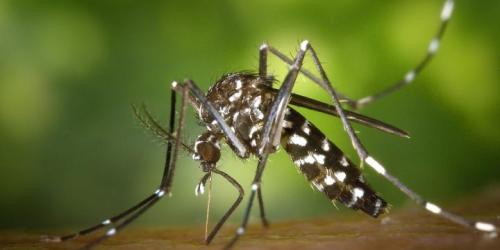
The tiger mosquito (Aedes albopictus), native to Asia, was introduced to Europe through international trade. This mosquito poses a public health threat because it carries certain diseases (dengue, chikungunya, zika,...).
The tiger mosquito is active during the day between May and October. It can be recognised by its small size, white spots and aggressiveness.

In 2024, tiger mosquitoes were reported in 21 municipalities in Belgium, including the City of Brussels for the first time.
Report a tiger mosquito?
To best organise the control of this mosquito, monitoring is carried out by Brussels Environment, Sciensano, the Institute of Tropical Medicine,...
If you suspect the presence of a tiger mosquito, you can report it via:
External siteMosquito surveillance (and upload a photo of the mosquito in the application)
If it is indeed a tiger mosquito, the authorities may contact you for an inspection by Sciensano and the Institute of Tropical Medicine. Based on their visit and advice, mosquito control may start in your area.
Avoid stagnant water
For its reproduction, the tiger mosquito likes stagnant water in artificial containers (bowls, pots, rain barrels,...). In the garden and around the house, it is therefore important to regularly change the water in animals' drinking troughs and remove all artificial containers with stagnant water.
Rain barrels can be fitted with a very fine-mesh screen.
Increase biodiversity
The increase of biodiversity in the public domain and private gardens gives the tiger mosquito less chance to survive (competition with other insects and the presence of natural enemies such as birds, amphibians,...).
Therefore, ponds and other pools of water with life and animals are not considered breeding grounds for tiger mosquitoes. Containers with stagnant water are thus the only danger.
More info?
External siteExotic mosquitoes in Brussels (in French and Dutch)