What is it about?
Inauguration of the 6 Marolles housing blocks on Wednesday 30 September 2026.
For many years, the City of Brussels has pursued an active policy of developing and redeveloping its public spaces. As part of the Marolles sustainable district contract, the 'Public Space Operations' section is planning the redevelopment of the interiors of six housing blocks and areas around social housing sites and public facilities.
The Marolles district contract covers a wide variety of public spaces. In addition to the district's 'iconic' streets (rue Blaes, rue Haute and place du Jeu de Balle), there are a large number of more 'intimate' public spaces that play an important role in the daily lives of Marollians: the interiors of blocks, the edges of social housing estates, smaller green spaces,... Some of these spaces are poor quality, do not easily lend themselves to a specific purpose or, on the other hand, suffer from intensive use.
The aim of the Marolles district contract is to enhance the value of these local areas by developing high-quality public spaces that are friendly, green, accessible to people with reduced mobility, open to a variety of uses and designed in consultation with residents. It also requires a coherent approach to all the blocks/public spaces, as well as the functional, technical and environmental principles (status and profile, materials, permeability, water management, lighting, vegetation,...).
The project has been developed with public participation in mind, incorporating the contributions and opinions of local residents.
Lacaille - Fleuriste
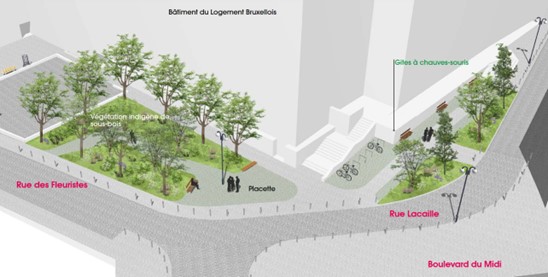
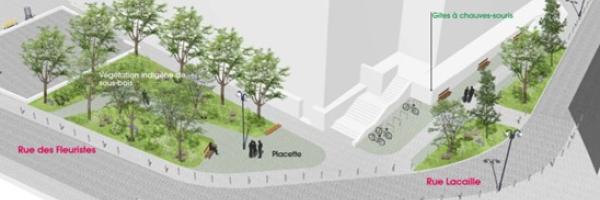
The buildings on the Lacaille-Fleuristes corner were demolished around 1970, making way for a social housing block. This was built back from the road, creating the square/space targeted by the project.
The project proposes to create a square with a high green density, but without compromising visibility and social surveillance. This area will mainly be intended for strolling and relaxing, to avoid creating conflicts of use.
The project includes:
- Enhancing existing trees
- Planting at the foot of trees
- Maximum soil permeability
- The installation of bike racks and a number of benches
Arrosoir

This site was occupied by family homes until the 1970s. This block of houses was demolished to make way for a wilderness/parking area. At the end of the 20th century, it was converted into a leisure area with a football pitch.
The aim of the project is to radically change the image and use of this area, which is currently regarded as dirty and unsafe. The strategy is to increase the number of uses, offer facilities for a wider public, make the site greener and encourage social interaction by making it safer.
The project includes:
- Intensive greening
- Maximum soil permeability
- Installation of bike racks
- Installation of a public toilet
- Creation of a playground
- Creation of a sports trail
Sainte-Thérèse
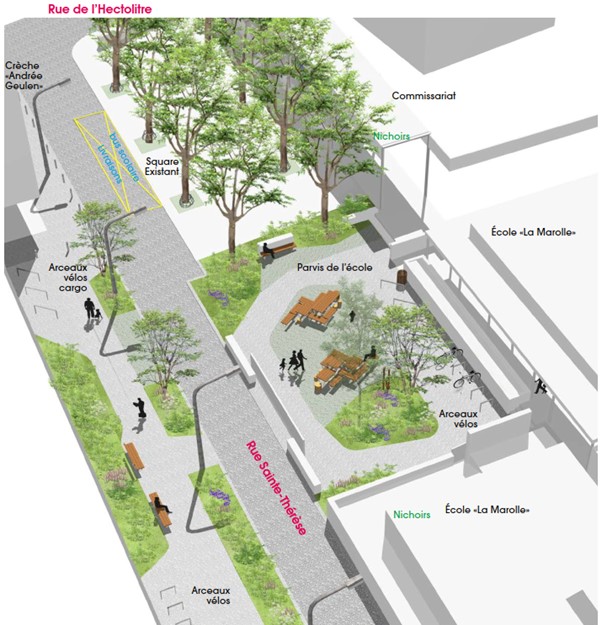
The single-family homes in this project area were built in the 1840s. These were demolished to make way for a nursery school. The school car park is currently located in our area of intervention.
Once freed of parking and unnecessary dividing walls, this public space can become a green and peaceful place. The school and nursery will be able to enjoy this beautiful, zen and playground-like forecourt. Without becoming a school street in the true sense of the word, it will be treated in accordance with the recommendations of the handbook for the development of school surroundings in the Brussels Region.
The project includes:
- Intensive greening
- Maximum soil permeability
- Installation of bike racks
- Installation of tables and benches
- Creation of a playground
- Creation of a sports trail
Porte-Rouge

Back in the day, this site was home to a distillery and vinegar factory. These buildings were demolished around 1960.
Nowadays, the whole park has turned into a playground, to the exclusion of other users. The plan is to divide the site into two zones: a play area at the top and a calm area at the bottom. By removing the gates to make it less enclosed and reworking the pavement alongside it, the park will be opened up and will work better with the neighbourhood. The pavement will become part of the square. A wooden play area module that takes advantage of the gradient will link the play area to the public space via a slide and a climbing wall.
The project includes:
- Increased biodiversity
- Maximum soil permeability and creation of a drainage ditch
- Installation of bike racks
- Installation of tables and benches
- Renovation of the playground (conservation of the roundabout, replacement of the swings, creation of a climbing wall and slide area)
Montserrat
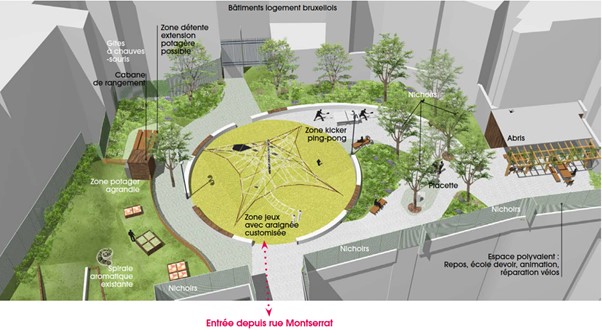
In 1974, the project site was renovated to include social housing in buildings renovated by 'Le Foyer Bruxellois' and 'ASSAM-Sorelo'. The plan was to create community gardens here.
The project builds on what is already working to expand and improve the site's uses: more play space, larger vegetable gardens, a high-performance shelter, a henhouse,... In consultation with users, the development will expand on existing uses and adapt them to ensure that existing initiatives continue.
The project includes:
- Facilities to attract wildlife (nesting boxes, bat houses,...)
- Installation of rainwater harvesting tanks
- Extension of the vegetable garden
- Development of a mobile henhouse
- Revamp of the shelter
- More tables and benches
Prévoyance
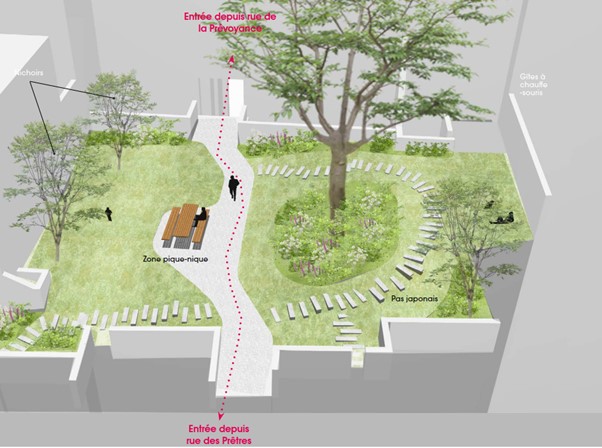
Extensions to the houses existed on the project site between 1900 and 1980. It has a similar history to the Montserrat site, where the buildings were taken over by the 'Foyer Bruxellois' and a community garden was created. The plan is to create a simple, multifunctional space.
Its fragmented architecture will be demolished in favour of an open space showcasing the large central plane tree.
The site will be open to residents and users/associations who will sign a joint, co-drafted charter.
The existing pathway will be retained, but renovated with draining concrete paving stones. Direct access from the ground floor terraces will be removed. The project aims to simplify a complicated, unsightly and non-functional landscape design in favour of a green, simple and versatile space.
The project includes:
- Facilities to attract wildlife (nesting boxes, bat houses,...)
- Installation of a picnic table accessible to people with reduced mobility
- Creation of a garden for calm activities
What purpose?
This project meets the following ambitions and objectives:
- To develop the green network and support active modes of transport and biodiversity
- To rebalance and diversify the use of public spaces
- To improve the safety and quality of public spaces for the purposes of living and environmental resilience
- To develop a strategy to reduce soil sealing in the City of Brussels and make its public spaces greener
- To create wildlife-friendly features in public spaces
- To speed up the development of a cycle network and provide appropriate bike parking facilities
- To ensure accessibility to all modes of transport for people with reduced mobility
- To incorporate inclusiveness criteria into public spaces from the design stage
- To address shortcomings in playgrounds and outdoor sports facilities
- To complete and extend the network of sanitary facilities