
What is it about?
This project is part of the Querelle Housing Block Contract, an action plan designed to improve the living environment of one or more blocks or an axis, with the following main objectives: de-densification and desealing, repurposing of buildings and public spaces, intensification of uses, and greater consideration for community projects.
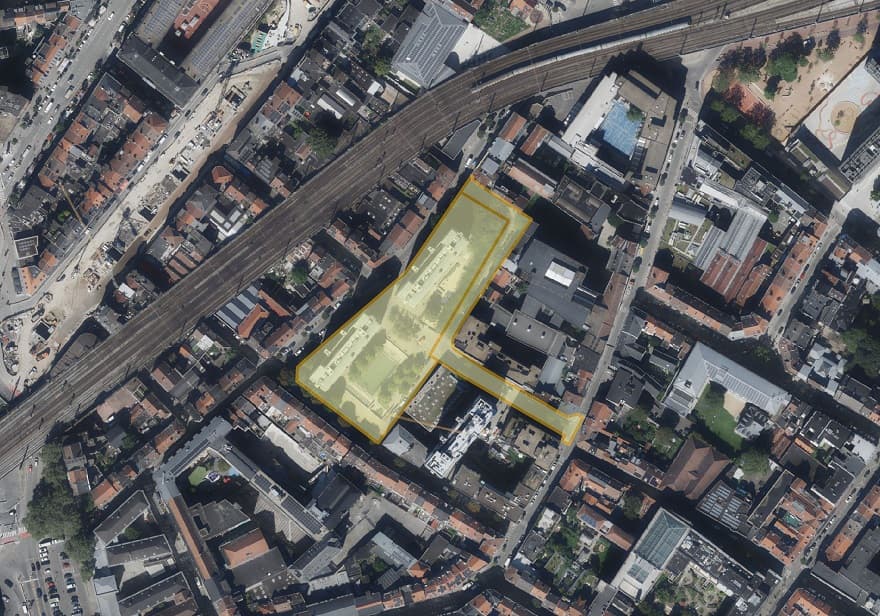
Located in the Marolles area, the Querelle neighbourhood has developed around high-rise buildings, freeing up a large area of public space on the ground. As housing with private outdoor space is rare, public spaces are used as places for community life and as 'gardens' for local residents.
The redevelopment project concerns the plain and its surroundings, as well as Rue Querelle and Rue Vanderhaegen. The adaptation of traffic is based on the STOP principle. This principle prioritises the organisation of means of transport and public space, focusing first on safety and access for pedestrians, followed by for cyclists, public transport and finally cars.
Plain and surroundings
The Querelle plain is the central public space in the Querelle neighbourhood. It includes a sports ground, a playground, a wooded area, grassy flowerbeds, as well as the approaches and access paths to the social housing buildings and public facilities.
Although some of the facilities, such as the sports ground and playground, are much appreciated, the facilities as a whole are in a poor state of repair and do not adequately meet the current needs of residents and users due to the intensive use of the area.
The City of Brussels plans to convert this space into a convivial public place that will promote well-being. The aim is to improve the coherence of the plain and make it more accessible to local residents. Actions will focus on several aspects: ground coverings, street furniture and self-service facilities for various communities (such as leisure and sports facilities, the sports field, the playground, rest areas,...), as well as vegetation, including high and low plants.
The project also includes integrated rain water management, improved street lighting, transport and car parking measures, the promotion of active mobility and improved safety.
Redevelopment of Rue de la Querelle and Rue Vanderhaegen
Rue de la Querelle and Rue Vanderhaegen run through the Querelle neighbourhood, linking Rue des Tanneurs to Rue Terre-Neuve. These streets are mainly used by local residents, with little car traffic. However, the current facilities have a number of shortcomings: they are in poor condition, the status of the roadway is unclear, the pavements are discontinuous, and so on.
The City of Brussels is planning to redevelop these streets to create a shared, peaceful space for all users. The project aims to meet current challenges such as pedestrian and cyclist safety, accessibility for people with reduced mobility (PRM), and environmental protection.
The interventions will cover a number of aspects:
- Ground coverings
- Street furniture
- Vegetation (promoting biodiversity, providing freshness, absorbing run-off water, or creating inaccessible spaces to enhance the privacy and security of ground-floor homes)
- Integrated rain water management
- Public lighting
- Mobility and car parking
- Making active mobility safer and more comfortable
What purpose?
This project meets the following ambitions and objectives:
- Developing the green network as a support for active transport methods and biodiversity
- Rebalancing and diversifying the uses of public spaces
- Incorporating inclusiveness criteria into public spaces from the design stage
- Improving the safety and quality of public spaces for the purposes of living and environmental resilience
- Developing a strategy to reduce soil sealing in the city of Brussels and make its public spaces greener
- Combatting urban heat islands
- Ensuring accessibility to all transport methods for people with reduced mobility
- Speeding up the development of a cycle network and providing appropriate bike parking facilities
- Creating peaceful neighbourhoods based on the STOP principle
