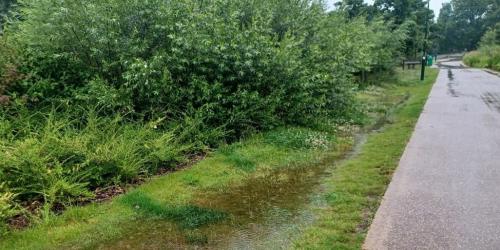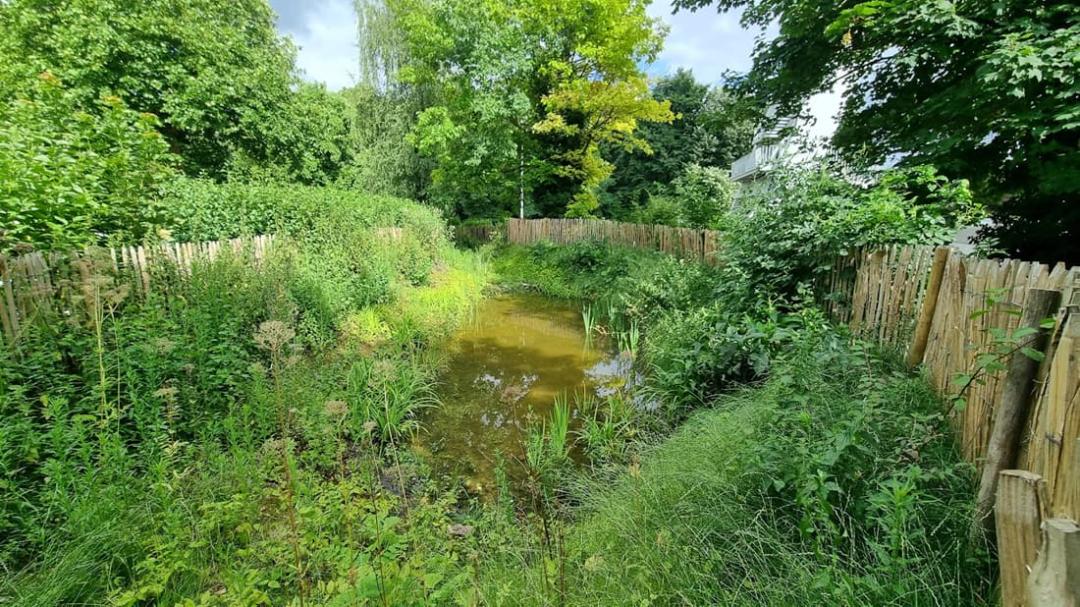
Integrated rainwater management (IRM) is a sustainable approach that rethinks urban water management and reorients it as much as possible towards a natural or nature-based water cycle, similar to a 'sponge city'.
This approach encourages the infiltration and storage of rainwater exactly where it falls, with the aim of:
- Preventing flooding by limiting runoff to the sewer system, which can become overloaded during heavy rainfall and cause damage downstream
- Strengthening vegetation, cooling the air and combating urban heat islands
- Support biodiversity by creating wet areas that are favourable to flora and fauna
- Save drinking water by using rainwater for applications such as watering or toilets
To achieve these goals, adjustments can be made at various levels (public spaces, public or private buildings), such as swales, pools, green roofs, depaving, rainwater wells,...
Below you will find examples of projects per neighbourhood and per player. These initiatives are supported by the City of Brussels or by private players or associations, with technical and/or financial support from the City.
Since 2021, Laeken has had a Priority Intervention Area for Integrated Rainwater Management. This is an area designated by the Board of Mayor and Aldermen of the City of Brussels, in which several goals have been set to tackle flooding problems in Laeken. These goals are also included in the Climate Plan of the City of Brussels, which was approved by the City Council in 2022.
All urban development projects, renovations or redesigns of public spaces within this zone must give priority to the infiltration and reuse of rainwater. In this way, they reinforce the natural sponge effect of the city. By 2030, 250,000 m² of roofs or paved surfaces in this zone must be disconnected from the sewerage network.
Map - Priority Intervention Area for Integrated Rainwater Management in Laeken (2.97 MB)
North of Laeken
In the north of Laeken, which is located within this zone, the European TRANS-lighthouses project is underway, facilitating participatory projects and works of varying sizes. The aim is to achieve 250,000 m² of depaved or disconnected surfaces.
Map showing all completed or ongoing IRM projects in Laeken (2.77 MB)
In the North Quarter, flooding is mainly caused by backflow from the sewer system. During heavy rainfall, water flows directly from paved surfaces into the sewers. This causes overload and can lead to sewers overflowing into basements whose drainage systems are not watertight. Vivaqua and the City of Brussels offer a free diagnosis to inspect your basement, with recommendations for the contractor of your choice. Consult the subsidies for more information on what you can do:
Throughout its territory, the City of Brussels carries out IRM through projects in public spaces or city buildings, but also by guiding and supporting citizens and private actors.
Are you interested in a project that has already been carried out or is currently underway in the City of Brussels? Please contact:
Urban Development - Climate and City in Transition
Would you like to carry out a similar project in your garden, school, building or car park? Find out about the bonus for water and biodiversity projects and the technical support offered by the City.
Do you live in Brussels?
Monique, a victim of flooding, took advantage of the subsidies and received help from the City to Ocean association to install IRM systems in her garden. A rain barrel collects water from her roof. When it is full, the excess water flows into a pool, which in turn overflows into a swale. A swale is an excavated and planted area that temporarily stores rainwater and allows it to infiltrate slowly. This feeds the groundwater and keeps the soil and plants moist, which cools the garden on hot days.
A company in Brussels?
Trademart (Heysel Plateau): a large part of car park P1 was disconnected from the sewer system thanks to the construction of a swale on the side of the car park. This swale is designed to cope with extreme rainfall that occurs on average only once every 100 years.
Combining heritage and rainwater infiltration?
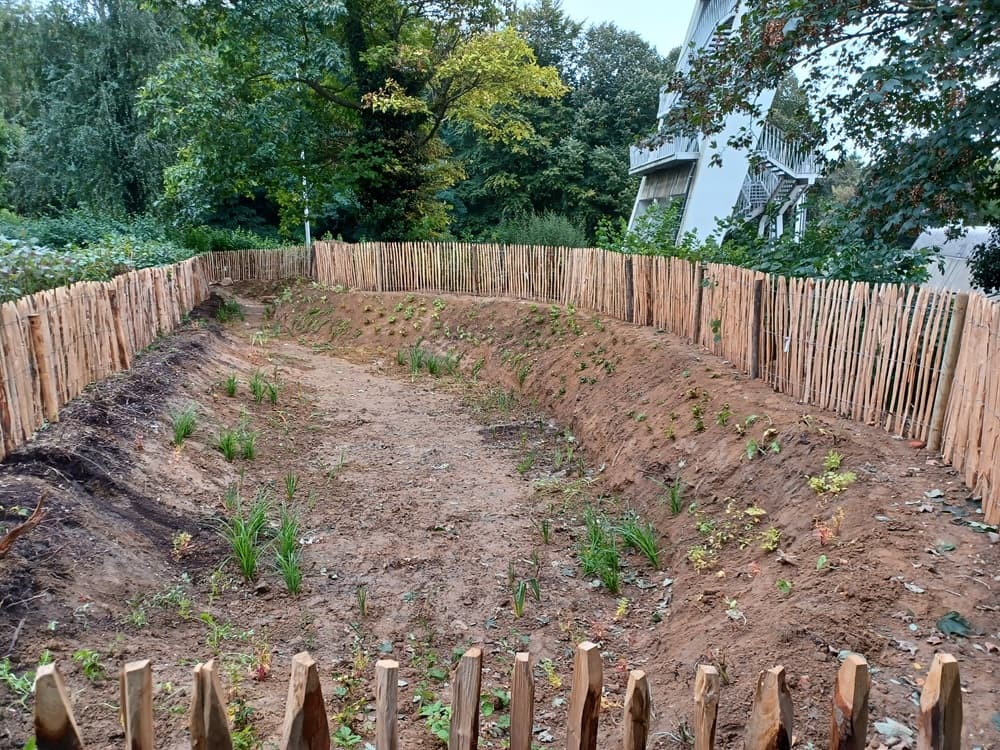
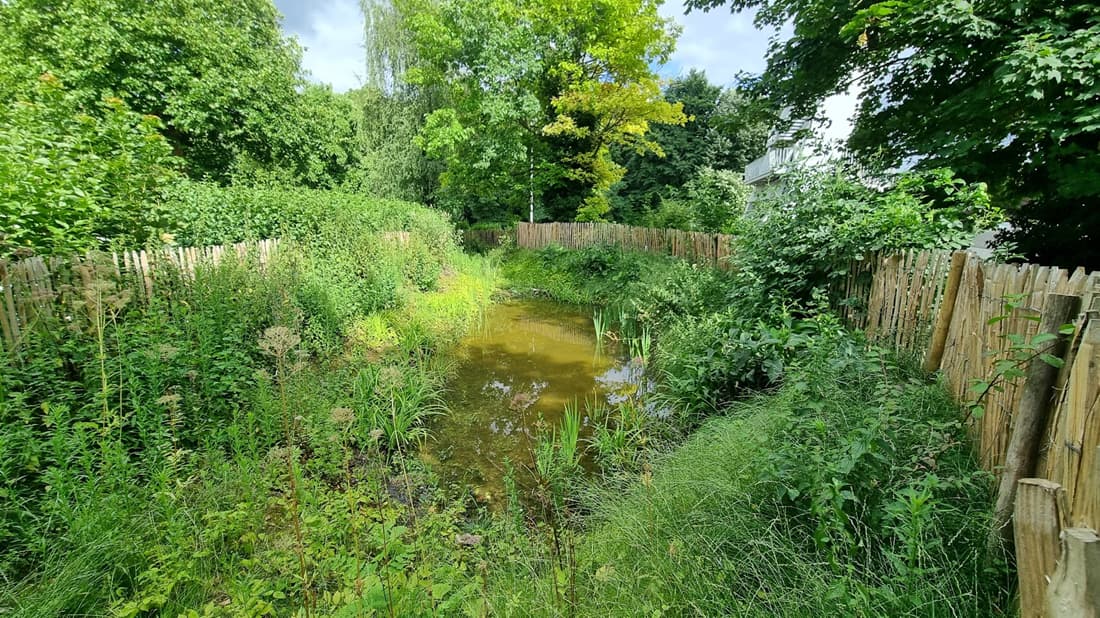
Jamaer House: the architects of the Latitude Platform agency and the City of Brussels have started a project in the listed building on the Avenue de Stalingrad. An existing rainwater cistern is being put back into use for toilets, an infiltration zone is being created and an old pond in the listed garden is being restored. Even in listed buildings, it is possible to implement IRM measures, and the grant provides guidance through all the administrative steps.
Greening and depaving public spaces
Place Marsupilami: this former roundabout in Laeken has been transformed into a play area that allows rainwater to permeate. The semi-permeable surface is surrounded by areas with vegetation.
Discover the project here (this video is in French with subtitles in French):
Schools as examples for water management
Emile Bockstael School (City of Brussels)
The school site was redesigned to allow rainwater to infiltrate and be reused. Hard surfaces have been replaced by water-permeable stones and semi-permeable soils. Various rainwater tanks collect water for flushing toilets.
Sint-Ursula School
This school in the lower-lying area of Laken regularly suffers from flooding in the playground. It applied for subsidies and received professional guidance from Latitude Platform, in collaboration with the City. A participatory process was launched with the pupils to design a playground that collects and reuses rainwater.
La Fraternité College
Also in lower Laken, this school received support from Latitude Platform and the City for a project that is eligible for a grant. The school's eco-team, a motivated group of pupils and teachers, collaborated to design a vision for their playground that focuses on rainwater management and a more pleasant, inclusive space. The pupils first learned about the water challenges in Brussels and then worked on a design that helps to limit flooding.