
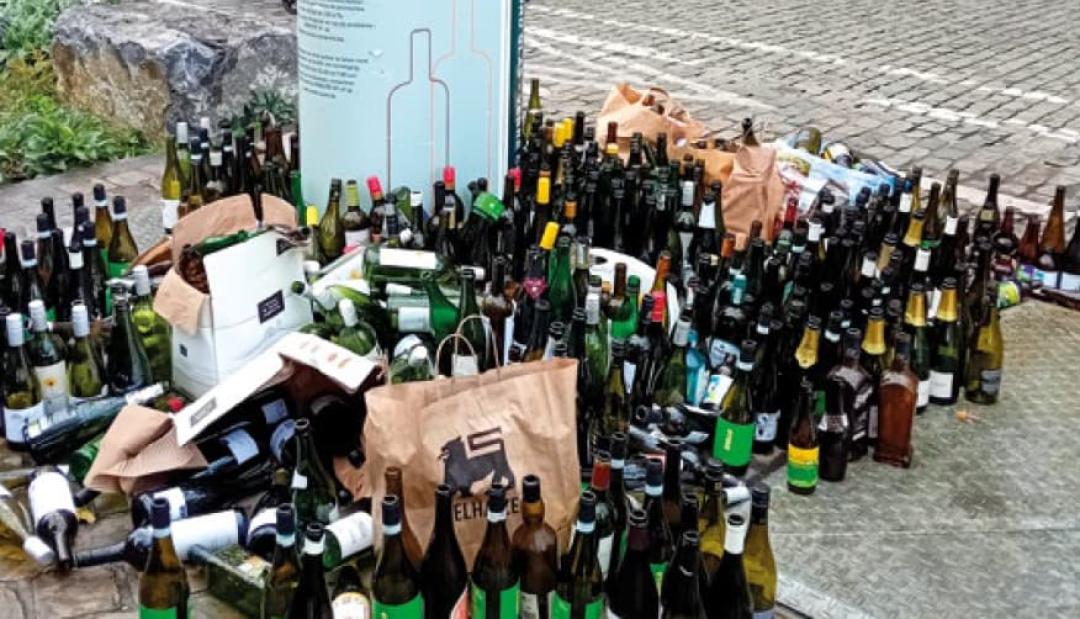
Everyone is familiar with the unpleasant sight of a bottle bank (glass container) surrounded by bags full of empty bottles and often other rubbish too. Please note that it is forbidden to place glass or rubbish next to the bin, even if it is full.
Leaving rubbish on public roads, even next to a rubbish bin, is a form of fly-tipping. After all, rubbish attracts more rubbish: one bag of glass can quickly turn into a lot of rubbish. Glass on public roads is also dangerous.
How to use bottle banks?
Here are a few rules for the correct use of a glass recycling bin:
- Only throw empty glass jars, non-deposit bottles and food containers (without caps or lids) in the bin. White glass belongs in the white bin and coloured glass in the green bin. Bruxelles-Propreté, the Regional Cleaning Agency, manages the glass recycling bins.
- The following items are strictly prohibited from being deposited in the bottle bank: lamps, heat-resistant glass (such as Pyrex), porcelain, pottery, crockery, crystal, stoneware, terracotta, flat glass, neon tubes or window panes.
- Empty bottles and jars and rinse them before placing them in the glass recycling bin. Liquid or sticky residues can spread an unpleasant odour and end up on public roads.
- Out of respect for local residents, it is prohibited to deposit glass between 10 pm and 7 am every day.
- Leaving glass or other waste next to the glass recycling bin is illegal dumping and is punishable by a fine of 500 euros per cubic metre.
Where to dispose of glass in Brussels?
List of glass containers (bottle banks)
Map of glass containers (bottle banks)
Consult or retrieve this data via open data
Full bottle bank?
Report it via:
- External siteFix My Street
- 0800 981 81 (Bruxelles-Propreté)

