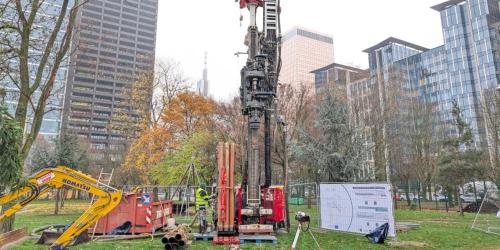
In 2028, a heating and cooling network will supply energy to the first group of buildings in the North Quarter, thanks to natural heat 150 metres below ground.
In the Positive Energy District (PED) of the North Quarter, a pilot project is changing the way buildings are heated and cooled: Be.SHARE. It is a future low-carbon heating and cooling network, designed at district level, to drastically reduce the use of fossil fuels and prepare the city for carbon neutrality. The network will be approximately one kilometre long and will gradually be extended to cover the entire PED.
Be.SHARE is a project led by Brussels Environment in partnership with Sibelga, Vivaqua, Karno, VUB and Convivence, with the active support of the City of Brussels, which is making its territory and experts available to the project. It has been selected by the European Urban Initiative (EUI) and is receiving European co-financing of around 5 million euros to develop this innovative thermal network in the North Quarter.
The aim is to create a network by 2028 that will supply heating and cooling to all types of buildings (offices, private and social housing) using local, carbon-free energy sources.
Unlike a conventional heating network, which uses very hot water for heating, this is a 'low-temperature' heating and cooling network, also known as a 5th generation network.
The network will operate with a double loop around 10°C and 20°C. This relatively low temperature makes it possible to:
- drastically improve the efficiency of heat pumps in buildings
- significantly reduce heat loss in pipes
- facilitate energy exchange between buildings that have different needs in mid-season (heating for some, cooling for others)
The project focuses on local and renewable energy sources:
- Firstly, geothermal energy: recovering heat from underground, beneath the roads and the Maximilian Park, a site owned by the City of Brussels, made available for seasonal storage of heat and cold thanks to the natural capacity of the ground to store heat and cold.
- Secondly, sewer thermal energy: recovering heat from the wastewater flowing through the neighbourhood's sewers. Just like Brucity!
- Aquathermal energy, possibly, for later phases: using the natural coolness and warmth of the canal.
These sources provide the heat and cold that the network needs throughout the year to maintain a temperature of around 15-20°C (just as Brucity already does).
Thus:
In winter, the buildings' heat pumps recover their calories from the 'warm' network. This is much easier and more efficient than in the freezing winter air. The heat pump's efficiency is simply doubled!
In summer, on the other hand, it is the circulation of cool water that prevents buildings from overheating.
Thus, the Maximilian Park will no longer be just a park. It will become - invisibly to users - a veritable 'power station' for the production and storage of heat and cold for the neighbourhood.
This marks a shift from a system where each building produces its own heat independently to a shared, much more efficient neighbourhood system. Thanks to this pooling of resources, as well as the City's land and energy planning, it is now possible to exploit the heat available beneath our feet and in public spaces on a large scale.
Be.SHARE is not just an engineering project. It also has an important social and participatory dimension: around 331 households in social housing will be involved from the outset, with specific support.
In line with the participatory actions carried out by the City, the non-profit organisation Convivence will work with local residents to ensure that the network becomes a shared and easily accessible project.
The aim is to make the energy transition accessible by combining:
- technical innovation
- climate protection (and consumer protection)
- the fight against energy poverty
This network will serve as a flagship project and will make it possible to:
- explore new energy transition models
- document energy savings
- prepare for the replication of this type of network in other neighbourhoods of the City, as part of its PED strategy
You own a building within the PED perimeter? And you would like to connect to the future heating and cooling network? Then join the community of interested parties.
To do so, send an e-mail to ped@brucity.be with the address and type of property (single-family home, apartment building, shop, office,...).
This information will help the City and its partners to better assess the neighbourhood's connection potential, inform you of the next steps and, when the time comes, contact you about specific connection opportunities.