A district heating network is a collective system for heating - and sometimes also cooling - buildings. It uses local sources and supports the energy transition at neighbourhood level.
Where district heating networks are a relevant solution, the City of Brussels plays an active role in their development within its territory. It brings partners together, helps projects move forward and ensures that they are developed in the interests of the neighbourhood.
In brief
- A district heating network is a collective infrastructure that delivers heat (and sometimes also cooling) to multiple buildings via underground pipes.
- It makes it possible to use local heat sources, reduce emissions and give concrete form to the energy transition at neighbourhood level.
- It replaces individual installations for heat and cooling production in buildings, either wholly or in part.
- The City of Brussels plays an active role in the development of relevant district heating projects within its territory and is already actively involved in various projects, including in Neder-Over-Heembeek and the North Quarter.
A district heating network is an infrastructure that distributes thermal energy (heat and sometimes also cooling) to multiple buildings via underground pipes.
Depending on the design, it can:
- supply heat only, for heating and sometimes also domestic hot water
- supply both heat and cooling, for cooling in the summer
In the latter case, we refer more precisely to a heating and cooling network or a thermal energy network.
In Brussels, the network project in the North Quarter is designed to supply both low-temperature heat and cooling. The network in Neder-Over-Heembeek, which is fed by recovered heat from the incineration plant, will, by contrast, supply only heat, and at a higher temperature.
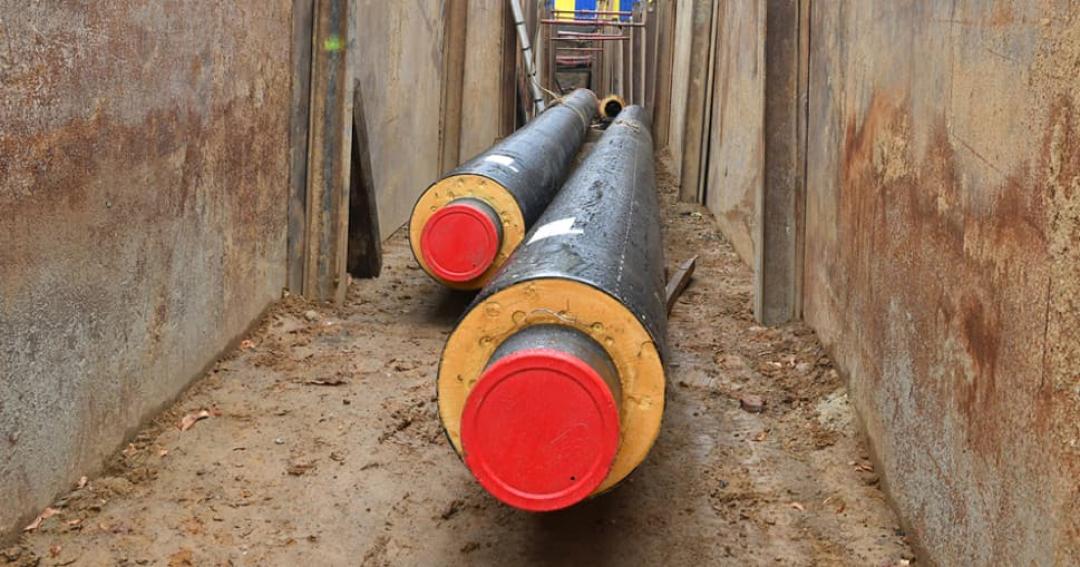
A heating network consists of underground, insulated pipes through which hot, lukewarm or sometimes cool water circulates to supply connected buildings with heat and/or cooling: homes, offices, schools, nurseries or public facilities.
Put simply: instead of having a boiler (and sometimes an air conditioning unit) in every building, the energy is produced or recovered elsewhere and then distributed collectively.
You can compare it to the electricity grid: production takes place elsewhere and the energy enters the building in a form that can be used immediately. This avoids the need to install and maintain large-scale production facilities in each building individually.
The principle is simple, the network operates in a closed circuit, via a loop:
- Heat or cooling is generated or recovered at one or more points.
- The network transports this energy to the connected buildings.
- Each building draws the heat or cooling it needs via a heat exchanger.
- The water then flows on through the network, past each connection point, before being reheated or cooled again at the production point or points of the loop.
In the most advanced networks, energy can also be exchanged between buildings. For example, in summer, a building that needs cooling can transfer energy to another building that needs heating. In this way, available resources are used even more effectively at neighbourhood level.
A distinction is usually made between two main categories:
Traditional heating networks (high temperature)
These heating networks distribute hot to very hot water, usually generated by combustion or large-scale heat recovery. The heat can be used directly in buildings, but good insulation is required to minimise heat loss.
Low-temperature networks
These heating networks operate with lukewarm water, lose less heat en route and offer more opportunities for cooling or energy exchange between buildings. These more recent networks also make it easier to use certain renewable energy sources. In some cases, due to the limited temperature, a small and highly efficient heat pump can be added locally to achieve the desired temperature within the building.
A district heating network is not tied to a single technology. It is a flexible infrastructure that can combine multiple energy sources and adapt over time to the seasons, local needs and opportunities.
Depending on the neighbourhood, the energy may, for example, come from:
- geothermal energy (heat from the ground)
- recovered heat from certain activities or installations, such as waste incineration
- collective heat pumps
- heat or cooling from waste water (sewer heat)
- heat or cooling from surface water (canal, pond,...)
- a combination of different sources
As a supplementary or emergency provision, and strictly limited, some installations can supplement the system:
- combined heat and power on (bio)gas
- an existing boiler that is temporarily retained as a safety reserve
Key advantage: a network can gradually become less dependent on fossil fuels, without connected buildings having to constantly adapt their systems. As with electricity, the evolution is mainly on the supply side.
District heating networks are a key driver of the energy transition in the city. Among other things, they make it possible to:
- reduce the use of gas and heating oil by using local, renewable or recovered sources
- reduce CO₂ emissions
- improve air quality by reducing individual combustion in densely built-up areas
- use heat sources that would otherwise be lost
- pool installations and investments at neighbourhood level
- simplify technical installations in buildings
- in certain cases, provide a coherent solution for urban cooling
These networks are particularly relevant in densely built-up areas, where a single pipeline route can serve multiple buildings. This enhances both the technical relevance of the project and its economic viability.
In Brussels, the areas with the greatest potential are mainly found in neighbourhoods where:
- building density is high
- heat demand is high
- heat and/or cooling sources are available nearby
In an urban context, such networks do not emerge spontaneously. They require the coordination of many stakeholders, the identification of the right zones, the exploitation of construction opportunities, the integration with ongoing urban projects, and a focus on the collective interest. It is precisely at this level that the City of Brussels plays a key role.
The heating and cooling of buildings account for a significant proportion of the city's energy consumption and CO₂ emissions. The development of district heating networks is therefore a key tool within the Climate Plan of the City of Brussels.
In this context, district heating networks make it possible, amongst other things, to:
- use local heat and cooling sources, including in public spaces
- support the development of more collective, sustainable and better-coordinated solutions, including within the framework of Positive Energy Districts (PED)
- offer solutions to gradually replace gas and other fossil fuel sources where individual sustainable solutions are more difficult to roll out or less suitable (technical constraints, noise, aesthetics, co-ownership,...)
The City of Brussels aims to play a structuring and pioneering role in the development of relevant district heating networks within its territory. It is working to identify suitable neighbourhoods, create the conditions for feasibility, bring together the relevant stakeholders, link these projects to ongoing urban dynamics, and support the creation of collective, sustainable and replicable solutions.
When a neighbourhood shows potential, the City of Brussels takes on various roles: identifying opportunities, supporting studies, facilitating coordination between stakeholders, linking the project to other developments or urban regeneration schemes, informing residents, and ensuring that the network's development remains coherent, realistic and beneficial to the neighbourhood.
Even when a network looks promising on paper, its implementation still depends on:
- the number of stakeholders, particularly among large consumers, who are willing to connect to a specific route at a specific time
- the ability to carry out the works at a reasonable cost
- opportunities, such as roadworks, major renovations or urban projects
- cooperation with other stakeholders from the public and private sectors
Not every neighbourhood is therefore suitable for a heating network. When a project does take shape, residents and local stakeholders will be informed.
The City of Brussels is currently actively involved in the following networks:
Studies and exploratory work are also underway elsewhere within the City of Brussels to identify new collective opportunities for decarbonisation.


